 DYNAMAX
Identify two-stroke versus four-stroke first, then compartment, clutch, viscosity, performance and service fill. Compare price and supply among fully suitable products rather than relying on brand rankings or thicker oil.
Build a six-step purchase checklist
- Identify model year and two/four-stroke design; age is not enough.
- Identify engine, final drive or separate gearbox.
- Record permitted SAE grade and operating conditions.
- Match all performance and clutch-class requirements.
- Check normal/filter-change quantities and measurement method.
- Verify exact-version data, traceable packaging and an actual quote.
Start scooter selection with model and year, not the smoothest brand. Establish two- or four-stroke oil, viscosity range, performance and friction class, then compare candidate bottles. Engine and final-drive oil are different fill locations; even when a model permits the same grade, quantities differ. A written fluid sheet gives each workshop the same clear requirements.
Keep four- and two-stroke classes separate
Four-stroke MA/MA2/MB classes do not classify two-stroke combustion lubricants. Automatic transmission alone does not establish MB suitability; some maxi-scooters differ. Meet any wet-clutch requirement before comparing cost.
A dry-clutch scooter may specify MB, but dry clutch or automatic transmission alone is not the complete decision. JASO describes friction behaviour and must match vehicle requirements; MA2 is not a universal scooter-protection upgrade. Two-stroke vehicles need their own classifications and delivery compatibility. Design and specifications come before price, grade or a motorcycle-only label.
Use verified PTT examples as candidates
| Manufacturer data | Selection condition |
|---|---|
| CHALLENGER SCOOTER | The English introduction lists MB and API SL; check your dry-clutch scooter and viscosity requirement. |
| CHALLENGER SYNTHETIC 4T 15W-50 | The product page lists MA2 and API SP; consider only where that grade/class is permitted, without transferring data to all versions. |
Reference: PTT: CHALLENGER SCOOTER for Automatic Motorcycles · PTT CHALLENGER SYNTHETIC 4T SAE 15W-50
The PTT examples point to different applications: CHALLENGER SCOOTER lists MB/SL and dry-clutch use, while the checked CHALLENGER SYNTHETIC 4T 15W-50 page lists MA2/SP. This is not a two-option recommendation, nor can one brand's sheets fill gaps in another product. Include a product only when its actual version meets every vehicle condition.
Reference: PTT: CHALLENGER SCOOTER for Automatic Motorcycles · PTT CHALLENGER SYNTHETIC 4T SAE 15W-50
Handle version and source differences
Older articles, catalogs and current product pages may show different API claims; do not combine the highest ones into one product. Ask DYNAMAX Petrochemical LTD. to check the actual Taiwan bottle/data before stock and price confirmation. A standards claim is not automatically an OEM approval.
Keep product name, grade, document date and bottle markings together. A series can change over time or differ by grade; older SL/SN descriptions and newer SP pages retain their own scope. Do not update an entire family for consistency. If a Taiwan bottle differs from the webpage, obtain matching documentation. A page does not prove local stock, price or formal approval.
Confirm refill and service execution
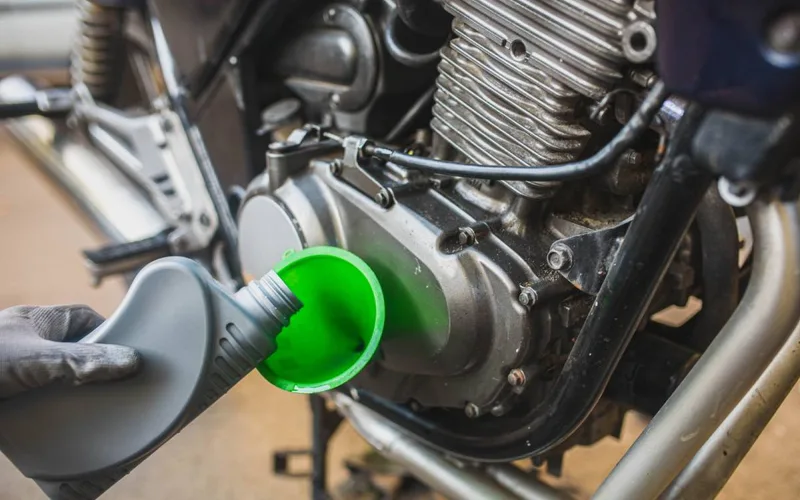
Service fill differs from overhaul capacity, and filter replacement can change quantity. Use proper tools, specified seals and torque rather than “usually 800 cc” for every scooter. Check level and leaks by the model procedure; resolve damaged threads or uncertain level before use.
Reference: Honda 2011 PCX125 Owner’s Manual
A suitable oil still needs correct filling. Routine drain, filter replacement and dry capacity after overhaul may differ; use the quantity for the actual task and verify level. The 2011 PCX125 provides an MB example, but its quantity or measurement procedure cannot be transferred to another scooter. Bottle remainder is not acceptance evidence; record actual fill and verification.
Reference: Honda 2011 PCX125 Owner’s Manual
Compare complete service cost
Compare fluid, filter/screen, seals and labor among suitable products. A synthetic label does not guarantee longer intervals. A mild climate does not justify excluding a manufacturer-specified low-W grade. Retain the work order and next deadline and investigate pressure or mechanical faults.
Reference: API: Engine Oil Licensing and Certification System
Compare quotations with matching product requirements and service scope. Clarify labour, washer, strainer/filter work, leak checks and next-due records. Bottle retail prices alone can misrepresent a complete service or omit necessary consumables. Riders need to know the actual work, product and next check, not merely a premium synthetic description.
Leaks, declining level or noise need inspection before product shopping. Have the workshop establish level, workmanship and fault clues before considering another compliant oil; thicker or dearer oil is not a repair promise. With no faults, a traceable suitable product and consistent records make changes easier to observe. Record the full specification whenever changing products.
Frequently asked questions
Q1. Can I buy directly from a top-three brand ranking?
Brands offer different applications and versions; confirm vehicle requirements and the exact product.
Q2. Does fully synthetic oil always extend service?
No. Check vehicle intervals and product instructions; the name does not authorize an extension.
Q3. Can I pour in the rest of a bottle?
Do not exceed the specified level. Store remaining oil as directed; package volume does not determine fill quantity.
Sources and applicable limits
- JASO T 903 Four-Stroke Cycle Gasoline Engine Oils Implementation Manual, 2016 edition / 2019 revision — Four-stroke friction-class purpose and limits. (Accessed 2026-10-08)
- Honda 2011 PCX125 Owner’s Manual — Manufacturer level/refill example, not a universal capacity. (Accessed 2026-10-08)
- PTT: CHALLENGER SCOOTER for Automatic Motorcycles — CHALLENGER SCOOTER manufacturer MB/SL and dry-clutch application description. (Accessed 2026-10-08)
- PTT CHALLENGER SYNTHETIC 4T SAE 15W-50 — Current 15W-50 manufacturer MA2/SP page, without inferring other versions. (Accessed 2026-10-08)
- API: Engine Oil Licensing and Certification System — Engine-performance marking and quality marks, not brand rankings. (Accessed 2026-10-08)