 DYNAMAX
First eliminate measurement differences, then distinguish external leakage, oil burning and other system faults. Record top-up quantity and mileage under consistent conditions rather than judging drain volume alone. Stop for an oil-pressure warning, rapid loss or overheating.
Confirm a genuine level decrease
Lean angle, temperature, waiting time and whether a dipstick is threaded in can change the reading. The PCX manual specifies its own level-check procedure; other models may differ. Measure on the same level surface using the same method and record date, mileage and top-up volume rather than calculating consumption solely from drained oil.
Reference: Honda 2011 PCX125 Owner’s Manual
Exclude filling/measurement errors: was filter-change quantity used without changing the filter, was a sight glass read on the side stand, or was return time inconsistent? Record levels under the same conditions with photos. Drain recovery depends on retention/tools. Without a baseline, a single volume difference should not be labeled consumption.
How to build a consumption record
For example, starting at the correct level and topping up 120 ml after 600 km under the same procedure gives 120÷600×1,000 = 200 ml per 1,000 km. This is a recordkeeping example, not a normal/fault threshold. Compare with model limits, operating conditions and the trend.
Consumption needs measured top-ups and comparable starting/ending levels, not one reading. Log each interval, volume, load/travel and product version to identify sudden increases. Per-1,000-km figures standardize records, not justify waiting for a warning. Correct low level promptly rather than running short of oil to complete a measurement.
Separate three inspection paths
| Clue | Inspection path |
|---|---|
| Oil on casing or ground | Check drain bolt, seal washer, oil seals and joints; clean before locating the leak. |
| Falling level without visible leak | Inspect ventilation, plugs and combustion-related condition; compression/leak-down testing may help. |
| Abnormal coolant/oil | On liquid-cooled models, check cross-contamination and cooling faults; emulsification alone does not prove a head-gasket failure. |
An external leak need not form a puddle: airflow, covers and nearby parts can retain/disperse it. Clean visible areas and observe fresh traces rather than interpreting old grime as current leakage. Oil on tires, brakes or hot exhaust areas introduces additional hazards. Use workshop diagnosis when the source is unclear rather than dismantling joints randomly.
Smoke does not identify one failed part
Burning oil often produces blue-gray smoke, but white smoke may be condensation or a liquid-cooling fault and lighting affects perception. Valve seals, rings, cylinder condition and ventilation can all contribute. Use timing, level trends and tests before prescribing a cylinder replacement.
Combine smoke with timing—cold start, after idling or under load. Valve seals, rings and ventilation are possible investigation paths, not parts identified by smoke alone. Compression/leak-down results have testing and interpretation limits and no universal value for every engine. Repair quotes should describe measurements, inspection and damage evidence before prescribing parts.
Topping up manages level, not the fault
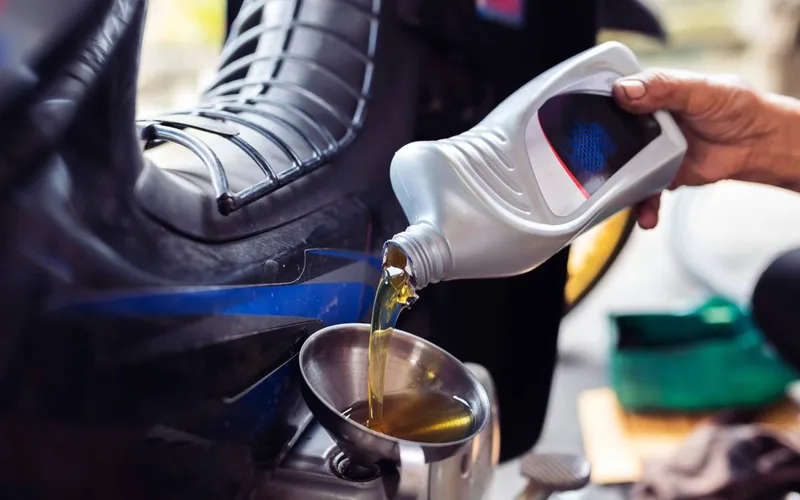
Add specified oil in small amounts to the correct range without exceeding maximum. BMW’s level guidance also calls for correcting excessive level, illustrating that more is not safer. Do not conceal rapid consumption with thicker oil, stop-leak additives or more frequent oil changes; establish the cause and repair plan.
Reference: BMW Motorrad R 1250 GS Adventure Rider’s Manual, 04/2023
Top-up oil must meet the full requirement; the thickest oil is not a consumption remedy. Avoid overfill by adding in stages and rechecking. If the previous version is unavailable, establish a suitable alternative and follow-up. Stop-leak discussion is product/situation-specific and cannot restore ring dimensions or replace mechanical diagnosis.
Workshop evidence and stop conditions
- Bring level photos, each top-up amount, mileage, lubricant and the circumstances of smoke.
- Ask the quote to identify test/inspection findings, proposed parts, labor and repair terms.
- For persistent pressure warning, rapid oil loss, knocking or overheating, shut down and arrange transport instead of repeated restarts.
Separate leak repair, consumption diagnosis and level management on the work order. Replacing one seal does not prove every consumption fault repaired. Monitor the comparable level trend after handover and return with records if it continues. Costs depend on findings and parts, not an undiagnosed flat price; starting successfully does not prove no damage.
Frequently asked questions
Q1. Is losing 100 cc always normal?
No universal amount establishes normality. Drain retention and measurement differ; record top-ups and compare with model requirements.
Q2. Can oil consumption occur without visible smoke?
Yes. Smoke may not be visible; track level and exclude leakage.
Q3. Can thicker oil repair worn rings?
It cannot restore worn dimensions or damaged sealing and may violate the oil specification.
Sources and applicable limits
- Honda 2011 PCX125 Owner’s Manual — PCX level-check procedure and insufficient-oil warning; not a universal consumption limit. (Accessed 2026-10-08)
- BMW Motorrad R 1250 GS Adventure Rider’s Manual, 04/2023 — Manufacturer level limits, excessive-level correction and measurement conditions. (Accessed 2026-10-08)