 DYNAMAX
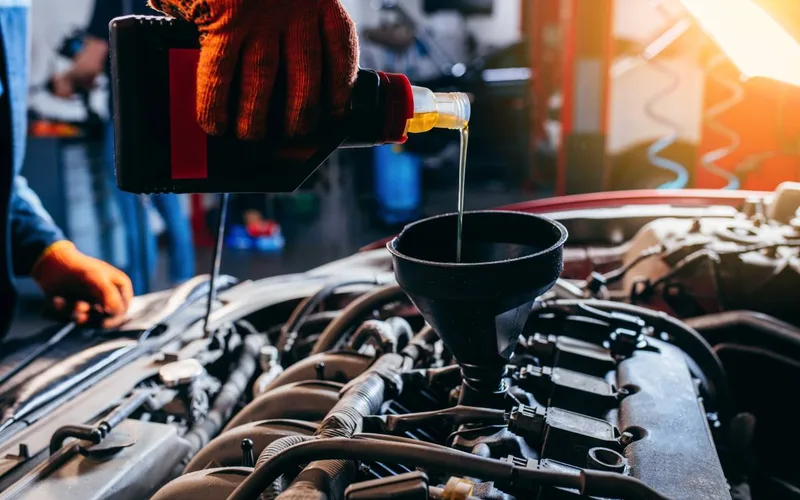
Measure correctly before removing excess oil. A rising level needs contamination diagnosis rather than removal alone. Emergency brand mixing still requires the correct viscosity and performance.
Rule out measurement error
Use the model's level-ground, engine-off wait time and dipstick or electronic-check procedure. One immediate reading or a slope can mislead. Distinguish filter-change, no-filter and dry-fill capacities; a stated capacity is not permission to pour it all in without checking.
Reference: Ford Owner's Manual: Engine Oil Check
Dipsticks and electronic systems have different prescribed procedures. The level range is not a direct total-liter gauge, and an unreadable dipstick does not justify pouring in full nominal capacity. Repeat the correct method and compare containers/work order, checking whether dry-fill capacity was mistaken for a routine change.
Reference: Ford Owner's Manual: Engine Oil Check
Why overfill matters
OEM guidance warns that filling above maximum can cause damage. Excess may affect churning, ventilation and oil-vapor control, with risk depending on engine and amount. There is no universal harmless extra volume, and absence of smoke does not prove safety.
Reference: Ford Owner's Manual: Engine Oil Check
Return to the allowed range rather than searching for a universal tolerated excess. Sump, rotating and ventilation designs differ; a friend's experience is not transferable. Symptoms may include smoke or running changes, or initially be subtle. Treatment and top-ups count toward total volume; no visible symptoms do not justify leaving an incorrect level.
Reference: Ford Owner's Manual: Engine Oil Check
Triage for abnormal levels
| Condition | Next step |
|---|---|
| Confirmed overfill after service | Remove excess and recheck correctly |
| Level rises without added oil | Investigate fuel or coolant contamination |
| Pressure warning, noise or heavy smoke | Stop driving and inspect |
A spontaneous rise needs more investigation than a known service overfill. Record recent duty and other clues such as coolant loss without diagnosing contamination by smell alone. Extraction can normalize the reading without addressing source or condition. Pressure, temperature or running abnormalities require stopping for diagnosis rather than waiting for the level to fall.
Removal requires safety and rechecking
Dipstick-tube extraction depends on design; electronic-level vehicles may lack suitable access. Draining needs safe support, hot-oil precautions, seals and torque control. Use a workshop without suitable equipment. Remove incrementally, recheck and inspect for leaks instead of inferring level from extracted volume.
Verify extraction access, clean equipment and container capacity. Drain-plug work needs safe support, temperature precautions, correct seals and torque; never work beneath a jack alone. Remove incrementally and recheck to avoid underfill, logging amount and result. New leakage after removal calls for checking service seals rather than dismissing it as age.
Discuss mixing only within suitable specifications
API advises matching viscosity and service category when brand mixing is necessary, but this does not establish every OEM, ACEA, clutch or aftertreatment requirement. Use the same product when possible; for urgent top-ups follow the manual, record additions and do not treat the mixture as newly approved.
Reference: API Motor Oil Guide
Brand difference is only one factor in urgent topping-up. Check grade, API/ACEA, OEM and clutch needs; seek a documented alternative under the manual. Record the amount and do not average different grades into an invented designation. Shared claims do not establish every blend ratio's approval; return to confirmed suitable oil at service.
Reference: API Motor Oil Guide
Find the reason for changing level
If a correctly filled sump rises weeks later with suspected fuel contamination, extracting to the normal mark does not address the cause. A falling level may reflect leakage or burning. Give the technician dates, mileage, additions and check conditions, retaining product details and avoiding extra treatment volume.
A consumption log needs dates, mileage, check conditions and additions, enough to show trends. A rise without additions points toward contamination investigation; a rise after treatment requires volume and service review. The same high reading can have different causes and responses. Bottles and invoices help distinguish correction from replacement and fault diagnosis.
Frequently asked questions
Q1. Is a little extra always harmless?
No guarantee. Stay within the OEM range rather than assuming a universal allowance.
Q2. Can same-grade brands always be mixed?
Not necessarily. Performance, OEM and special-system requirements still matter.
Q3. Does extraction complete the diagnosis?
A spontaneous rise needs investigation; a service overfill still needs level and leak checks.
Sources and applicable limits
- Ford Owner's Manual: Engine Oil Check — Oil level, filling and supplemental-additive restrictions; a model-specific example, not a rule for every vehicle. (Accessed 2026-10-08)
- API Motor Oil Guide — API/ILSAC categories, marks and compatibility; does not verify a particular product license. (Accessed 2026-10-08)