 DYNAMAX
Chain lubricant is replenished externally after cleaning rather than drained like engine oil. Confirm seal compatibility and rotate the wheel by hand with the engine off. Stiff links, damaged seals and excessive elongation cannot be fixed by extra spray.
Sealed chains still need external care
O-rings/X-rings retain grease inside the joints, while external lubricant helps exposed surfaces and corrosion protection. Spray cannot restore grease lost through damaged seals. Confirm chain type together with cleaner compatibility.
Reference: D.I.D: Frequently Asked Questions
External lubricant supports surfaces, roller contact and corrosion protection rather than replacing grease inside sealed joints. Damaged/missing seals change lubrication and contamination control; heavy spraying cannot restore the design. Buy explicitly seal-compatible cleaner while following chain-maker restrictions. A shiny result does not prove safety.
A safe cleaning and lubrication sequence
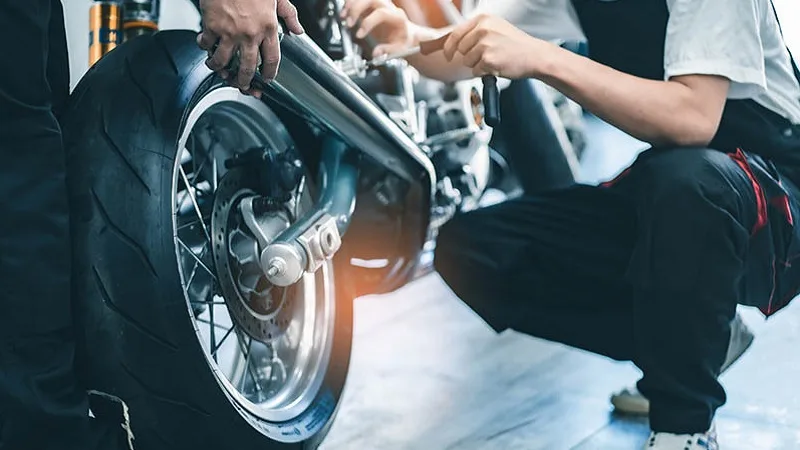
- Switch the engine off, prevent accidental starting and support the bike as prescribed. Keep hands away from sprocket pinch points; never power the wheel with the engine.
- Use seal-compatible cleaner and a soft cloth; remove contamination and dry as directed.
- Turn the wheel by hand in sections, apply to the indicated areas and shield the tire and brakes.
- Remove excess, follow the lubricant’s setting time and check slack and tight/loose variation around the chain.
Prevent accidental starting after secure support. Turn slowly by hand and keep fingers/cloth away from sprocket pinch points. Control spray, protect tread/discs/friction material and follow ventilation/safety guidance. Without suitable wheel support, use a manufacturer-approved incremental method; do not power the chain to save time.
Let the chain maker govern cleaner choice
D.I.D’s FAQ advises against kerosene and warns about volatile solvents, wire brushes and steam. Habit does not establish compatibility. Another chain maker’s different method applies only to its specified products. Bicycle practices such as ultrasonic cleaning, reversing or routine removal should not be transferred automatically to motorcycle chains.
Reference: D.I.D: Frequently Asked Questions
Dry as directed before lubricating rather than trapping moisture beneath grime. Setting time depends on the lubricant, not a universal few minutes; riding too early can fling unset material. Avoid both omitting lubrication to stay clean and treating thick sludge as protection. Inspect, clean, dry, apply appropriately and recheck, reassessing after rain or dirt.
Inspect before lubricating
| Finding | Action |
|---|---|
| Dirty or dry surfaces | Clean, dry and replenish with compatible lubricant. |
| Stiff links or missing seals | Inspect and assess replacement; extra lubricant is not a repair. |
| Large slack variation | Check elongation, sprockets and adjustment. |
| Worn sprockets / chain beyond limit | Replace matching components according to chain and vehicle limits. |
Reference: D.I.D: Chain Maintenance
Do not measure slack at an arbitrary point. Check a full rotation and use specified position, posture and load. Overtightening affects suspension movement and loads; excessive slack can cause impact/interference. Exhausted adjustment, binding or abnormal elongation calls for replacement assessment rather than moving the wheel back indefinitely; inspect sprockets too.
Schedule and record care
Start with vehicle and chain-maker guidance and inspect after rain, washing, dust and long journeys. Record mileage, care date, slack and measurement method. For adjustment, verify posture, load and the tightest point; overtightening is not a remedy for movement.
Record cleaner, lubricant and chain model as well as care dates so compatibility can be checked. Photos help compare seals, plates and sprockets but do not replace elongation measurement. Check cleaning requirements before changing product types rather than layering oil, dry-film and wax products. A shiny spray finish is not proof of complete service.
When to stop using the chain
Stop for cracked plates, faulty connecting links, marked binding or contact with the chassis. Resolve lubricant contamination on tires or friction material before use. Connecting links must match the chain and riveting requirements; improvised pressing is unsuitable.
Connecting links are structural components; clip and rivet designs are not interchangeable by appearance. Reconnection needs matching parts, tools and specified measurements. Removing a chain for deep cleaning is not necessarily better than approved on-bike care. Stop for loose links or cracked plates. Persistent noise/vibration after care also warrants sprocket, axle and alignment checks.
Frequently asked questions
Q1. Must every trace of lubricant be removed?
Remove exterior contamination according to instructions; do not damage seals to wash internal grease.
Q2. Does more spray mean longer life?
Excess can fling onto nearby parts and retain dirt; apply and wipe as instructed.
Q3. Can I lubricate with the engine spinning the wheel?
No. Rotate by hand with the engine off and avoid chain/sprocket pinch points.
Sources and applicable limits
- D.I.D: Frequently Asked Questions — D.I.D seal-compatible care, kerosene warning and damage criteria, limited to its guidance. (Accessed 2026-10-08)
- D.I.D: Chain Maintenance — Chain elongation, seals, connecting-link inspection and replacement guidance. (Accessed 2026-10-08)